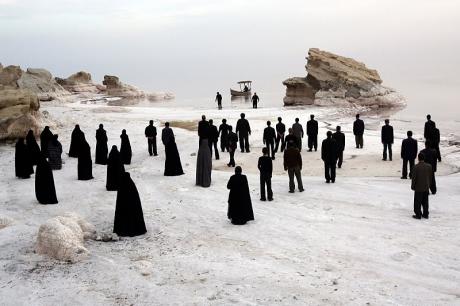
I'm very excited to have been involved in the making of this film series at Asia Society. It starts Friday 25, 2011. Also, there will be a panel discussion focused on Panahi's work on Wednesday, March 2, 2011, 6:45 pm at Asia Society.
The panel highlights the cinematic achievement of filmmaker Jafar Panahi and explores the current state of creative expression in Iran.
Speakers include: Hamid Dabashi (Columbia University-Moderator), Hadi Ghaemi (International Campaign for Human Rights in Iran), Negar Mottahedeh (Duke University), Richard Peña (Film Society of Lincoln Center/Columbia University).
This post is about the ingenuity and creativity of revolutionary consciousness and less about technological savvy and mass uprisings. But that is where I will start.
I started thinking, once again about my research on the Iranian uprising after the presidential election of 2009, and found Mark Colvin's recollections of that period at the 2009 Media 140 conference above useful. Something I had missed: #iranelection as a hashtag (or search topic) on Twitter emerged at the same time as the hashtag #CNNfail. In esssence, #CNNfail testified to the problem the world encountered with traditional media (such as CNN) as masses of people were struggling for their rights under a repressive regime.
In the past few weeks, the world has been a witness to revoutionary uprisings in Tunisia, Yemen, Jordan, Libya, Gabon and Egypt. Masses of people have bravely risen to demand basic human rights, freedom and democracy. Alert to the possibilities opened up by the Wikileaks crisis, our attention has been hooked on the online stream of information: on Al-Jazeera's online broadcast, as well as the tweets and blogs that reach our shores from the ground as new events unfold.
Now, as taken as I am with the uses of new technologies in bringing about change in the context of mass uprisings, I am equally, if not more, fascinated these days, by the poetics, that is, the ingenuity and the creativity of the revolutionary consciousness, a consciousness that, in its receptivity, creates the possibility for transformation all around it.
The German literary critic Walter Benjamin spoke of this consciousness in terms of childhood, (because it shows up with greater clarity in childhood than in adulthood) where the child's mimetic faculty sees correspondences between things --and in the revolutionary context, between past and present events-- "by means of spontaneous fantasy". In this way, this consciousness opens up new possibilities while also constructing the contexts for the child's own entry into the world. This gallery of photos of the helmets of the Egypt uprising shows both the symptoms and the signs of this revolutionary consciousness to my mind.
As Susan Buck-Morss suggests: “The revolutionary ‘signal’ which ”proceeds ‘out of the world in which the child lives and gives commands” is the capacity for mimetic improvisation “…of perception and active transformation”. This mimetic consciousness is a revolutionary consciousness, by means of which “new forces and new impulses appear..."
Of the child's drawers, Benjamin writes: They must become arsenal and zoo, crime museum and crypt. “To tidy up” would be to demolish an edifice full of prickley chestnuts that are spiky clubs, tinfoil that is hoarded silver, bricks that are coffins, cacti that are totem-poles and copper pennies that are shields.” [See Susan Buck-Morss's brilliant piece on Walter Benjamin: Revolutionary Writer for these quotes)
This ability to see correspondences --say, between past and present-- shifts consciousness into another temporal dimension of 'now-time’ -- a potent attentiveness in the present--"in which both revelation and revolution" occur.
This transformation in consciousness is the revolution that is (there on the streets and squares, but also here in our minds and in fact, ) everywhere. To quote Ludacris on this matter, because frankly, he put it most succinctly : When I move you move. Just like that.
My mother, Faezeh Seddigh, is a very talented architect and artist. I admire her. I always have. And I always wanted to be just like her. As a child I used to hang out at her studio,where she and other architecture PhDs worked under Houshang Seyhoun's supervision. I wanted to be them. They were so much fun to be around when I was a toddler. Many of them are still my friends.
Forty years have passed since those days in Tehran and I still remember my mother vividly in the light of that space. I also remember the sparkling amber color, and the scent, of the brewed Persian tea that was served as these young architects created their designs for Iran.
Then, sometime last April, I met Talinn Grigor. She's a Professor of Fine Arts at Brandeis and a critic of Iranian architecture. When we met at an academic conference where we both gave papers in Austin, she was writing this book which is in part on the legacy left by Houshang Seyhoun in his work as an architect under the Pahlavis. I'm thrilled to have reviewed it for Iranian Studies. It is absolutely brilliant and reads like a detective story. I suggest you run out and buy it.
Talinn Grigor's Building Iran: Modernism, Architecture and National Heritage under the Pahlavi Monarchs Grigor Review
Since I lived in New York in 2001, I've had one dream and one goal only (besides writing my books, working on being a great educator and practicing my yoga), that dream was to return to New York (triumphant) and have a place I could call my own. Last year, around this time, that dream came true. I came back to New York with tenure at Duke University, and thanks to my great broker, Michael Villani, I bought my own little place close to the Hudson, on hallowed ground. (I have to tell you more about the "hallowed" part some day).
This year, I am going for another dream, thanks to the love and encouragement of my powerful coach Hildie Dunn at the Handel Group, and that is to write articles in magazines, like Elle and Vogue and who knows, maybe someday, The New Yorker.
I am designing this dream playful and joyfully and with a huge dose of focus and intention. So to start things off in a fun way, I've created a Tumblr account where I will keep track of ideas for things I might write about.
I love New York and I still live my life in Gotham with a sense of wonder ~ Like Amelie ~ Negar in NYC is New York City's Amelie in Paris.
I AM sooooo excited! Join me in designing your own dreams! Dream along with me! Come explore the City with me! Give me feedback on my writing! And let's live like there's no tomorrow!
As the school year begins, I would like to share this wonderful piece by Melinda Blau on the internet and the Relationship Revolution. Thanks to Cathy Davidson for bringining the piece to my attention.
I don't think that a sustained discussion of what defines a woman and what the character of feminism is today would have happened had both Boobquake and Brainquake not happened. The question is, how do we sustain this discussion once it's been generated in social media in the cracks and crevices created by two duelling quakes?
As Lina Srivasta writes, "social media in its present forms is limited in its ability to create a sustained, long-term effective movement." Social media is great for bringing together like minds across the globe, great for testing ideas, great for ephemeral debates, but if we want to sustain a focused educational discussion or an educational campaign on a global scale, what do we do? Where do we go next? That's where my thinking stalls today.
Perhaps as my colleagues Ed Webb and Lisa M Lane write, we'll be just fine without permanence, "let the data flow past, focus on the now, the experience, rather than seeking to hold on to anything."
Meanwhile the Brainquake team is still uploading photos and biographies of amazingly talented, creative, intelligent and dazzlingly capable women on the Brainquake Fan Page and on the Brainquake Tumblr site. Check it out and keep sending up your stories and uploading important news; keep sharing your comments and ideas and keep putting up your photos of women who made a difference in whatever way, large or small.